Your True Score (Net Worth)
Net worth measures your true financial position—what you own minus what you owe. Learn why this number matters more than salary and how to think about wealth clearly.


TL;DR: How to Think Differently
- Your salary tells you how much you earn; your net worth tells you how much you have — most people confuse the two
- Net worth is what you own minus what you owe — it's the only number that measures actual financial position
- Someone earning ₹50,000 can be wealthier than someone earning ₹2,00,000 if the first person owns more than they owe and the second owes more than they own
- A high net worth doesn't announce itself — it doesn't drive a nice car or wear expensive clothes; it sits quietly in the gap between assets and debts
- Your net worth can be negative, and that's information, not a moral judgment — it just means you owe more than you own, which is fixable once you see it clearly
- Growing net worth is the game; everything else is scorekeeping — income, spending, saving, investing all matter only to the extent they increase this one number
Who This Is For
This is for anyone who has ever felt wealthy on payday and broke by month-end.
If you've looked at your salary and felt like you should be doing better financially but can't figure out why, this is for you. If you've compared yourself to friends or colleagues and felt confused about who's actually ahead, this is for you. If you earn a good income but somehow don't feel financially secure, this is for you.
This is especially for people who've been measuring their financial success by the wrong metric—income instead of accumulation.
You're not failing. You're just keeping score in a game that doesn't actually determine the winner.
The Cousin Who Earns Less But Owns More
Let me tell you about two people.
Person A earns ₹1,80,000 a month. Software engineer. Has a ₹15 lakh car on loan (₹8 lakhs outstanding). Lives in a rented apartment (₹35,000/month). Has ₹4 lakhs in savings. Has ₹6 lakhs in mutual funds. Owes ₹3 lakhs on credit cards. Spends ₹1,50,000 monthly.
Person B earns ₹60,000 a month. Government job. Has a 10-year-old two-wheeler (paid off, worth ₹20,000). Lives in a small flat inherited from parents (worth ₹30 lakhs, no loan). Has ₹8 lakhs in FDs and PPF. Has ₹5 lakhs in mutual funds. No debt. Spends ₹40,000 monthly.
When you meet them at a family wedding, Person A looks more successful. Better dressed. Confident. Talks about foreign trips and new gadgets.
But here's what you don't see:
Person A's net worth:
- Assets: ₹4L (savings) + ₹6L (investments) = ₹10 lakhs
- Liabilities: ₹8L (car loan) + ₹3L (credit cards) = ₹11 lakhs
- Net Worth: -₹1 lakh
Person B's net worth:
- Assets: ₹30L (flat) + ₹8L (FDs/PPF) + ₹5L (investments) + ₹0.2L (two-wheeler) = ₹43.2 lakhs
- Liabilities: ₹0
- Net Worth: ₹43.2 lakhs
Person A earns three times more.
Person B is 40+ times wealthier.
This is the difference between income and net worth.
What This Number Actually Measures
Net worth is absurdly simple:
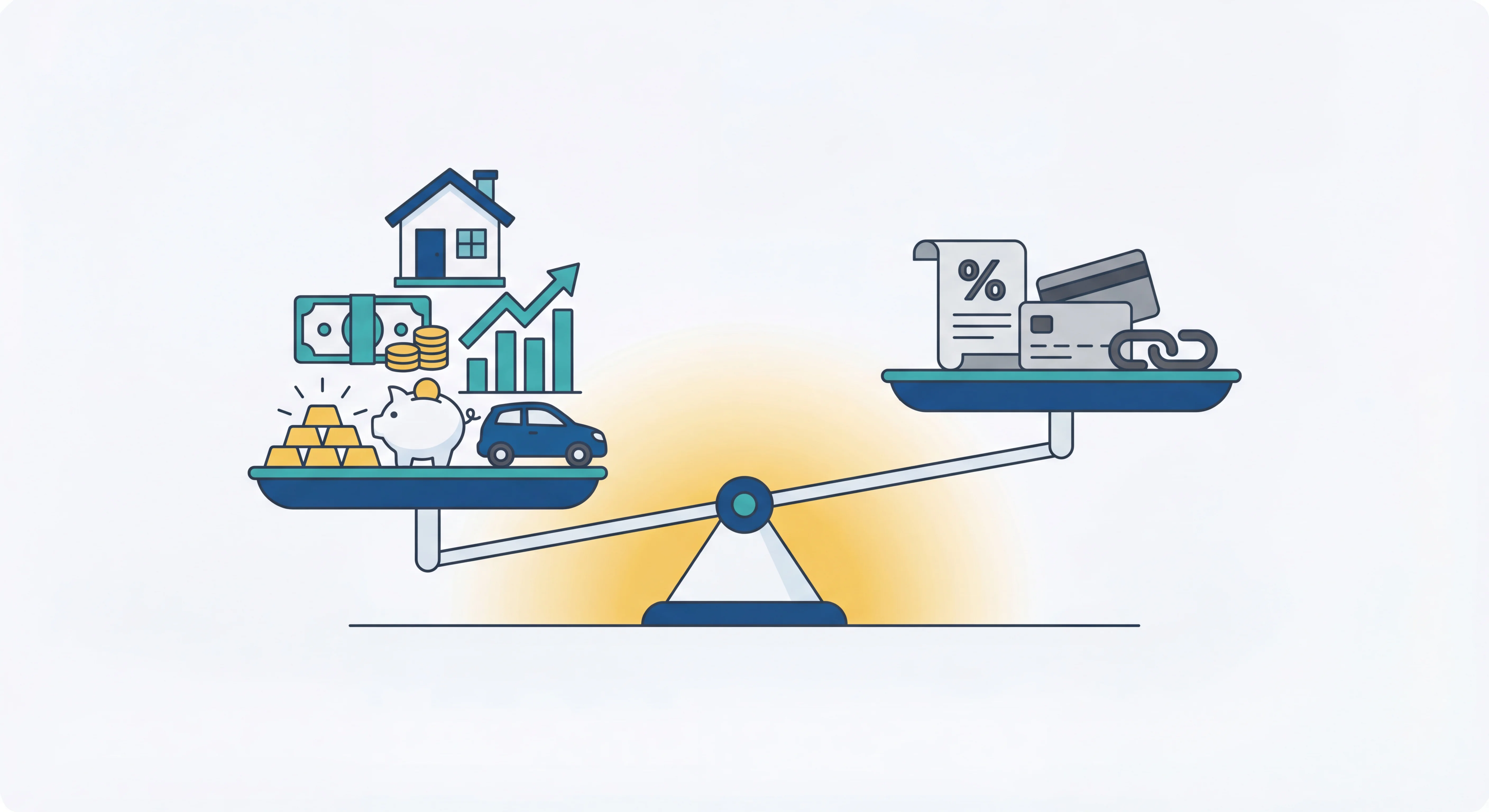
Net Worth = Total Assets - Total Liabilities
Or in plain language:
Net Worth = What You Own - What You Owe
That's it. That's the formula.
Everything you could sell for money, minus everything you need to pay back.
This is your true financial position. Not your salary. Not your job title. Not the car you drive or the neighborhood you live in.
Just: if you liquidated everything today and paid off every debt, how much would you have left?
That number—positive, negative, or zero—is where you actually stand.
What Counts as Assets
Liquid Assets (easily convertible to cash):
- Bank savings
- Fixed deposits
- Liquid mutual funds
- Cash
Invested Assets (takes time to convert, but has value):
- Equity mutual funds
- Stocks
- PPF, NSC, other long-term instruments
- Gold (if in pure form or bonds)
Use Assets (things you use that still have market value):
- House/flat (at current market value, not purchase price)
- Car/vehicle (current resale value, not what you paid)
- Gold jewelry (after deducting making charges)
What Counts as Liabilities
Everything you owe:
- Home loan outstanding
- Car loan outstanding
- Personal loans
- Credit card debt
- Education loans
- Money borrowed from family/friends
That's all that matters for this calculation.
Notice what's missing: rent, monthly expenses, your EMI amount. Those don't directly go into net worth. They affect how fast net worth grows, but they're not part of the number itself.
The Math That Actually Matters
Let's look at some real scenarios to see how this plays out.
Scenario 1: Fresh Graduate
Age 23. Just got first job at ₹8 lakhs per year.
Assets:
- Savings: ₹50,000
- Mutual funds: ₹0 (just started SIP)
- Total Assets: ₹50,000
Liabilities:
- Education loan: ₹12 lakhs
- Total Liabilities: ₹12 lakhs
Net Worth: -₹11.5 lakhs
Negative. And that's completely normal. This person has just started.
Scenario 2: Mid-Career Professional
Age 35. Earning ₹25 lakhs per year. Bought a flat 5 years ago.
Assets:
- Flat: ₹85 lakhs (current value)
- Savings/FD: ₹5 lakhs
- Mutual funds: ₹15 lakhs
- Car: ₹6 lakhs (resale value)
- PPF: ₹8 lakhs
- Total Assets: ₹1.19 crores
Liabilities:
- Home loan outstanding: ₹45 lakhs
- Car loan: ₹3 lakhs
- Total Liabilities: ₹48 lakhs
Net Worth: ₹71 lakhs
Solid. Building steadily despite the home loan.
Scenario 3: High-Earning, High-Spending
Age 40. Earning ₹50 lakhs per year. Lives in an expensive city.
Assets:
- Rented home (no property)
- Savings: ₹3 lakhs
- Mutual funds: ₹20 lakhs
- Car: ₹12 lakhs (resale value)
- Gold jewelry: ₹8 lakhs
- Total Assets: ₹43 lakhs
Liabilities:
- Car loan: ₹8 lakhs
- Credit cards: ₹5 lakhs
- Personal loan: ₹7 lakhs
- Total Liabilities: ₹20 lakhs
Net Worth: ₹23 lakhs
High income. But lower net worth than the person earning half as much, because spending kept pace with earning.
Scenario 4: Inherited Wealth
Age 32. Earning ₹12 lakhs per year. Simple lifestyle.
Assets:
- Flat (inherited, paid off): ₹40 lakhs
- Agricultural land (inherited): ₹25 lakhs
- Savings/FD: ₹10 lakhs
- Mutual funds: ₹8 lakhs
- Two-wheeler: ₹50,000
- Total Assets: ₹83.5 lakhs
Liabilities: ₹0
Net Worth: ₹83.5 lakhs
Lowest income of the four. Highest net worth.
This is what inheritance does—it separates income from wealth completely.
Why People Don't Know This Number
Most people know:
- Their salary to the rupee
- Their bank balance
- How much their home loan EMI is
- What their car cost when they bought it
Most people don't know:
- What their house is worth today
- What their car could sell for
- Their total mutual fund value
- Their net worth
Why?
Because salary is visible. EMI is painful. Bank balance is checked daily.
But net worth requires you to:
- List everything you own
- Value it honestly at today's prices
- List everything you owe
- Do the subtraction
That feels like work. And it might reveal something uncomfortable.
So people avoid it.
They know their income but not their wealth. They track flow but not accumulation.
And that's why people who earn well can still feel financially insecure—they don't actually know their position.
The Misunderstandings
"My salary is high, so I must be doing well"
A ₹2 lakh monthly salary sounds impressive.
But if your monthly outflow is also ₹2 lakhs, your net worth isn't growing.
And if you're using debt to maintain your lifestyle, your net worth might be shrinking.
High income with no accumulation is just expensive maintenance, not wealth building.
"I own a house, so I'm wealthy"
Your house is worth ₹1 crore. Congratulations.
But if you owe ₹80 lakhs on the home loan, your net position from that house is ₹20 lakhs, not ₹1 crore.
And if that's your only significant asset, your net worth is ₹20 lakhs, not ₹1 crore.
Ownership is different from equity. What matters is how much of it you actually own.
"I have no debt, so my net worth is my salary"
Not even close.
Net worth isn't income. It's accumulation.
You could earn ₹50,000 a month, have no debt, but if you also have no savings or investments or property, your net worth is close to zero.
No debt is good. But zero debt plus zero assets equals zero wealth.
"My car and gold jewelry are my wealth"
Your car that cost ₹12 lakhs three years ago is worth ₹6 lakhs today if you sell it.
Your gold jewelry that cost ₹5 lakhs has ₹80,000 in making charges you'll never recover.
These things have value, yes. But not the value you think.
Market value is what counts, not purchase price or emotional value.
"Net worth doesn't matter until retirement"
Your net worth is either growing or shrinking every single month right now.
If you're 30 and your net worth is negative or stagnant, and you don't change anything, you'll reach 50 with a negative or stagnant net worth.
Time doesn't fix this. Direction does.
Net worth growth is the compounding game. Starting late means giving up years of exponential growth.
How to Think About This Going Forward
Net Worth Is the Scoreboard
Think of your financial life as a game.
Your salary is how many points you score each month.
Your spending is how many points you give away.
Your investments are points you bank for later.
Your debts are negative points.
Net worth is your total score.
You can score a lot of points (high income) but still lose the game if you're giving away more than you're banking.
The Only Number That Measures Freedom
Here's what net worth actually represents: optionality.
A high net worth means:
- You can survive without working for longer
- You can take career risks
- You can say no to things you don't want
- You can handle emergencies without panic
- You can retire earlier if you want
A low or negative net worth means:
- You need your next paycheck
- You can't afford disruption
- You have no buffer
- You're locked into your current path
Net worth is stored freedom.
The Growth Rate Matters More Than the Number
A 25-year-old with ₹2 lakh net worth growing at 20% per year is in a better position than a 40-year-old with ₹15 lakh net worth growing at 5% per year.
Because the trajectory determines the destination.
It's not where you are. It's which direction you're going and how fast.
Two Levers, Infinite Combinations
To grow net worth, you have exactly two levers:
Lever 1: Increase assets
- Earn more
- Save more
- Invest in things that appreciate
- Build passive income
Lever 2: Decrease liabilities
- Pay off debt faster
- Avoid new debt
- Don't finance depreciating purchases
Everyone's financial life is just these two levers being pulled in different combinations.
High income people often pull Lever 1 hard while ignoring Lever 2.
Result: Fast inflow, fast outflow, stagnant net worth.
Wealth builders pull both levers.
Result: Income grows, debt shrinks, net worth compounds.
The Comparison That Matters
Stop comparing salaries.
₹50,000/month vs ₹2,00,000/month tells you nothing about financial position.
Start comparing net worth trajectory.
Person A: ₹5 lakh net worth growing to ₹8 lakhs next year (+60%)
Person B: ₹40 lakh net worth growing to ₹42 lakhs next year (+5%)
Person A is building faster, even though Person B has more.
Net Worth as a Reality Check
Your net worth is the most honest number in your financial life.
You can lie to yourself about your spending.
You can rationalize your lifestyle.
You can pretend you're doing fine.
But net worth doesn't lie.
Calculate it once, and you know exactly where you stand.
Calculate it every year, and you know exactly whether you're progressing.
What This Connects To
Net worth is the integration of everything else you'll learn.
Every financial decision you make—how much to save, where to invest, whether to take a loan, what to buy, how to budget—matters only to the extent that it increases your net worth over time.
- Budgeting matters because it creates surplus that grows net worth
- Investing matters because it grows assets faster than inflation
- Avoiding bad debt matters because debt drags down net worth
- Emergency funds matter because they protect net worth from forced liquidation
Later, you'll learn to calculate net worth precisely. You'll learn to track its growth. You'll learn to optimize the two levers. You'll learn to set net worth targets for different life goals.
But all of that starts here, with this simple awareness:
The number that matters isn't what you earn. It's what you keep minus what you owe.
That's your true score.
And right now, you might not even know what it is.
The Number You're Avoiding
Here's the uncomfortable truth:
Most people avoid calculating their net worth because they suspect it's lower than they want to admit.
They'd rather not know.
They'd rather focus on salary (which feels good) or spending (which feels justified) or vague plans (which feel reassuring).
But not knowing doesn't change the number. It just keeps you blind to it.
And you can't improve what you won't measure.
The person earning ₹3 lakhs a month with a net worth of ₹10 lakhs isn't wealthier than the person earning ₹80,000 a month with a net worth of ₹50 lakhs.
They just look wealthier.
The person with no debt and no assets isn't in a good position. They're in a neutral one—better than negative, but not yet building.
The person with ₹1 crore in assets and ₹95 lakhs in debt hasn't "made it." They're only ₹5 lakhs ahead, and one bad year could erase that.
Net worth cuts through all the stories you tell yourself and shows you the math.
And the math doesn't care about your intentions or your effort or your education or your title.
It just shows you: what you own, what you owe, and the difference.
That difference is your financial reality.
Everything else is just narrative.
Actionable
The First Net Worth Calculation
This might be the most revealing 20 minutes you spend on your finances. You're going to calculate your net worth. Not estimate. Actually calculate.
Observation List:
- 1List your assets
- 2List your liabilities
- 3Calculate
- 4Sit with the number
- 5The trajectory question
What you'll need:
- Your phone or a piece of paper
- Bank statements or banking app
- Investment statements (mutual funds, PPF, stocks if any)
- Loan statements (home, car, personal, credit card)
- 20 minutes of honesty
Step 1: List your assets
Write down everything you own that has market value:
Liquid Assets:
- Savings account balance: ₹_______
- FDs: ₹_______
- Liquid mutual funds: ₹_______
- Cash at home: ₹_______
Invested Assets:
- Equity mutual funds (current value): ₹_______
- Stocks (current value): ₹_______
- PPF: ₹_______
- Other investments: ₹_______
Use Assets:
- House/flat (realistic market value today, not purchase price): ₹_______
- Car/vehicle (realistic resale value today): ₹_______
- Gold (subtract 15-20% from purchase value for making charges): ₹_______
- Other valuable items: ₹_______
Total Assets: ₹_______
Step 2: List your liabilities
Write down everything you owe, to the rupee:
- Home loan outstanding: ₹_______
- Car loan outstanding: ₹_______
- Personal loan: ₹_______
- Education loan: ₹_______
- Credit card balance: ₹_______
- Money borrowed from family/friends: ₹_______
- Any other debt: ₹_______
Total Liabilities: ₹_______
Step 3: Calculate
Net Worth = Total Assets - Total Liabilities
Your Net Worth: ₹_______
Step 4: Sit with the number
This is your true financial position. Not your salary. Not your job title. Not what you look like to others.
This is what you actually have after paying everything you owe.
Now ask yourself:
-
Is the number higher or lower than you expected?
-
Is it positive or negative?
- If negative: How long would it take to reach zero at your current savings rate?
- If positive: How long did it take you to build this? What was the trajectory?
-
What's the biggest component of your assets? (Usually house for older people, investments for younger)
-
What's the biggest component of your liabilities? (Usually home loan)
-
If you kept doing exactly what you're doing now, what would this number be in 5 years?
Step 5: The trajectory question
Calculate a simple growth rate:
If your net worth today is ₹X and last year it was ₹Y:
Growth = (X - Y) / Y × 100
Example:
- Today: ₹15 lakhs
- Last year: ₹10 lakhs
- Growth = (15 - 10) / 10 × 100 = 50%
If you don't know last year's number, that's information too—it means you've never tracked this before.
The uncomfortable insights:
Many people discover:
- Their net worth is negative despite years of working
- They have more liabilities than assets
- Most of their "wealth" is locked in one house with a big loan
- Their liquid assets are shockingly low
- Their trajectory is flat or negative
None of this is shameful. It's just information.
But now you know. And knowing is where change begins.
LEARNING OUTCOME:
This exercise builds the foundational skill of honest financial self-assessment. Most people live their entire financial lives without ever calculating this number, which means they're navigating blind. By forcing the calculation, you confront reality—not what you hope you have, not what you think you should have, but what you actually have right now. The number itself matters less than the act of seeing it clearly. Many people are shocked to realize their net worth is much lower than expected, or that it's negative, or that years of "good salary" haven't translated to wealth accumulation. Others are pleasantly surprised that they're doing better than they felt. Either way, you now have a baseline. You know your score. And once you know it, you can track whether it's growing or shrinking each year. This single number becomes your true financial compass—the metric that cuts through all the noise and shows you whether you're actually building wealth or just maintaining a lifestyle. Everything else you learn about money will ultimately serve this one goal: increasing this number over time.
Smit Panchal
Chartered Accountant | Writing about Money, Clearly
Smit simplifies complex money concepts through first-principles thinking and real-world insights. Writing on personal finance, wealth frameworks, and financial clarity—beyond noise, products, and hype. Views expressed are personal and educational.
Connect on LinkedIn